
This is usually the first real fork in the road, and families in Bangalore rarely get a straight answer, because the honest answer is that it depends on the same handful of things every time. Here is how to actually work it out for your own situation, rather than going on what worked for a neighbour's parent.
What home care actually solves well
A trained attendant at home works well when the need is fairly stable — help with bathing, dressing, medication reminders, company through the day — and when the home itself is reasonably safe to move around in. It also keeps a parent in familiar surroundings, which matters enormously for someone whose main anxiety is change itself.
Where home care quietly runs out of road
The gaps tend to show up in three places. First, medical escalation: a single attendant cannot manage a fall, a fever spike or a medication reaction at 3am the way a facility with nursing staff on-site can. Second, therapy: physiotherapy delivered once or twice a week at home is maintenance, not recovery — real rehabilitation needs daily, supervised sessions, which is very hard to arrange at home. Third, caregiver load: home care usually means a family member is still the one making decisions, coordinating shifts, and stepping in when an attendant is unwell or unavailable.

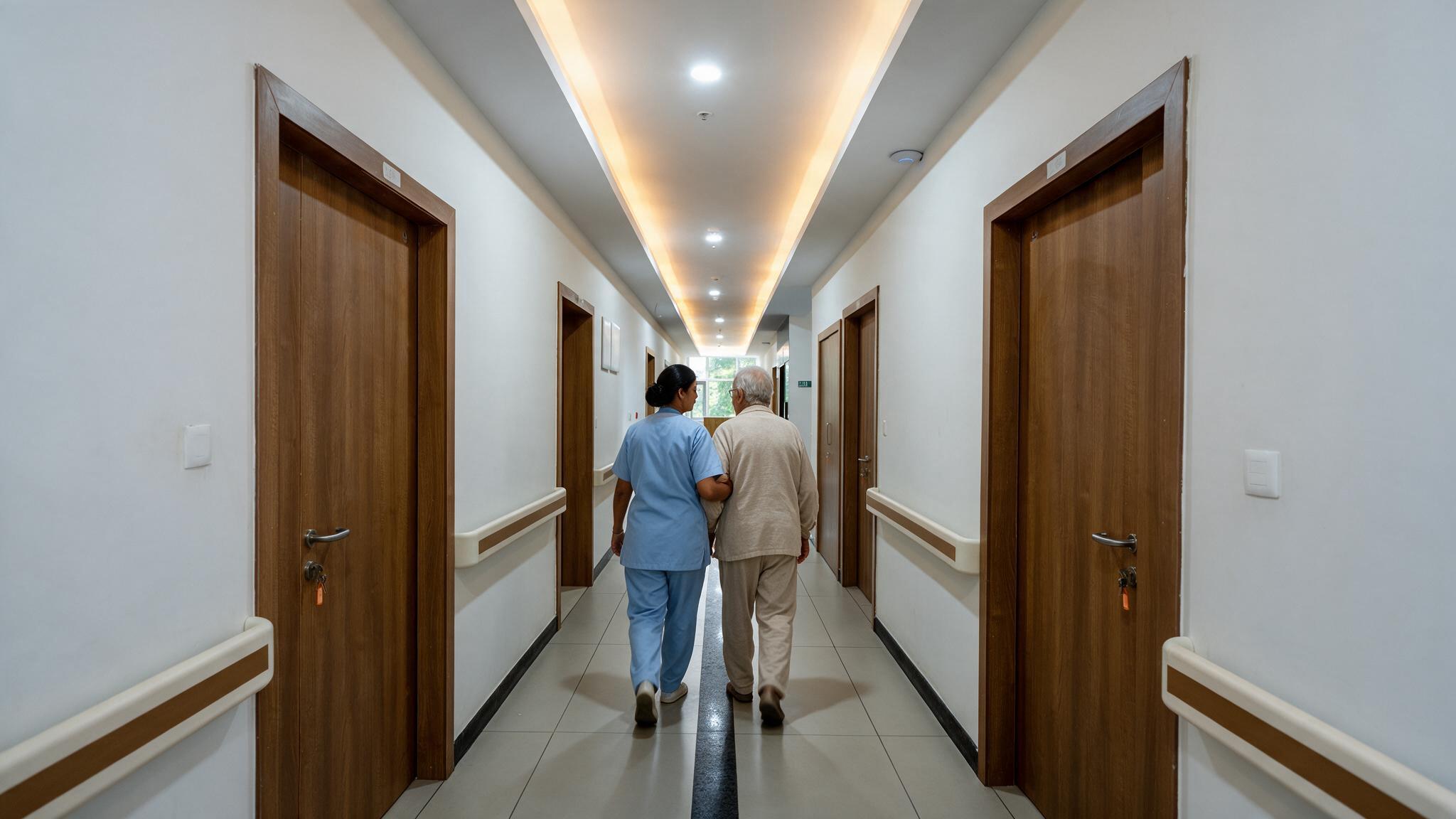
A residential facility adds round-the-clock clinical presence rather than a single attendant.
What a residential facility adds
A purpose-built facility folds nursing supervision, physiotherapy, meals, medication management and safety features (handrails, wheelchair-accessible bathrooms, a nurse-call system) into one roof, so escalation doesn't depend on one attendant's judgement at 3am. It also takes the day-to-day coordination off the family, which is often the more exhausting part.
A practical way to decide
Is the need stable, or does it change week to week?
Does recovery depend on daily therapy, not weekly?
Has there been a fall, a hospital admission, or a near-miss recently?
Is one family member quietly doing the coordination of multiple attendants and doctors?
Would a short trial stay answer the question better than a debate?
Families rarely need to choose once and for all. Many start with home care, add a short residential stay after a hospital discharge, and decide from there with real information instead of guesswork.
Heritage Care clinical team
While our expertise is rooted in geriatric and elderly care, we support adults of all ages, and a short assessment — whether or not it leads to an admission with us — is usually the fastest way to see which option actually fits.